
Why packaging data matters more than a broad green promise
Packaging sustainability is becoming a practical sourcing question, not just a front-label theme. ISO 14021:2026, published in June 2026, establishes principles and requirements for self-declared environmental claims about products and their environmental statement programmes. ISO says the document applies to words, symbols or graphics on product and package labels, product literature, technical bulletins, advertising and digital platforms, and describes documentation and methodologies for assessing such claims. It is not a destination-market law for every cleaner, but it shows why buyers should expect precise evidence when comparing packs and considering environmental wording.
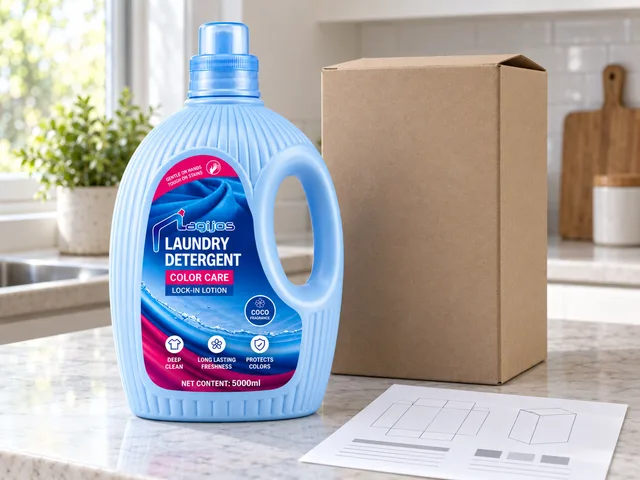
The buyer task is therefore to turn a sustainability conversation into a controlled specification. Do not begin with a claim such as eco-friendly packaging. Begin with the exact SKU, fill volume, bottle or pouch structure, closure, label, carton and shipment configuration. Record the mass and material of each component, the protection requirement, the intended collection or disposal route and the evidence supplied by the manufacturer. A clear data sheet lets a retailer, importer and supplier discuss the same pack without treating an attractive phrase as proof of environmental performance.
Build a comparable pack data sheet
Start with a component map. For a liquid laundry detergent, list the bottle, cap, handle, label, adhesive, inner protection, outer carton and pallet or stretch-wrap route if those items are part of the shipment brief. Ask for the finished pack weight and the weight of each major component where available. Record dimensions, units per carton, carton dimensions and whether the proposed format changes the number of units that can move safely in a container. A lighter bottle is not automatically a better commercial choice if leakage, deformation or extra protective material increases waste and claims risk.
Then add decision fields rather than unsupported conclusions. A useful comparison table can show virgin or recycled material content as a percentage only when the supplier can substantiate the figure; whether components are designed to be separated; the intended reuse, refill or recycling assumption; and the market or collection system on which that assumption depends. Add a document column for supplier declaration, bill of materials, packaging drawing, test record or local confirmation. Mark unknown values as pending. That is stronger than filling gaps with a generic sustainability badge.
Compare redesign, reuse, refill and material choices
The OECD Environmental Performance Review of Slovenia, published on 11 September 2026, says planned advanced EPR fee modulation would encourage recyclable and reduced packaging and recommends stronger waste-prevention measures and mandatory shares for reusable beverage containers. Its wider circular-economy recommendations make the buyer lesson practical: a circular objective cannot be reduced to one material substitution. When comparing a bottle, refill pouch or larger family pack, assess the whole use and distribution system. Consider how the product is dosed, protected, displayed, transported, opened, stored and managed after use. A format that looks efficient at the factory may create a different burden in retail or household handling.
Make the comparison commercial and testable. For each option, record product-to-pack ratio, pack protection, expected leakage controls, carton efficiency, label area, closure compatibility, sample observations and the documents still required. A reuse or refill concept needs a defined return, cleaning or consumer-use assumption; it should not be presented as automatically lower-impact. Recycled-content wording needs a verified percentage, scope and chain-of-custody basis where the destination market requires it. If the evidence is not ready, use neutral specification language and keep the claim out of the artwork.
Turn the brief into an approval gate
Before requesting a 2,000 ml laundry detergent sample or approving a private-label layout, ask the supplier to return the same fields for the proposed pack. Compare the catalog reference with the revised option and note any changes to bottle geometry, cap, handle, label panel, carton count, gross weight and shipping marks. Ask which values are measured, calculated or still provisional. Keep formula, safety, transport and packaging questions separate, but link the files by SKU and revision so a packaging change does not silently detach from the product documents.
Finally, route every environmental statement through a claim review. ISO 14021:2026 makes documentation and assessment methods part of the conversation, while the OECD review stresses coordinated policy and monitoring rather than slogans. Neither source validates a supplier's specific claim, recycled percentage, recyclability result or compliance status. Confirm destination-market requirements with qualified local advisers, retain the source and date for each material statement, and approve artwork only after the evidence matches the exact pack. This process protects the buyer from SKU confusion and gives the supplier a precise RFQ brief.
Official reference sources
These general references support buyer checks. The importer remains responsible for confirming the rules that apply to the final formula, classification and destination market.