
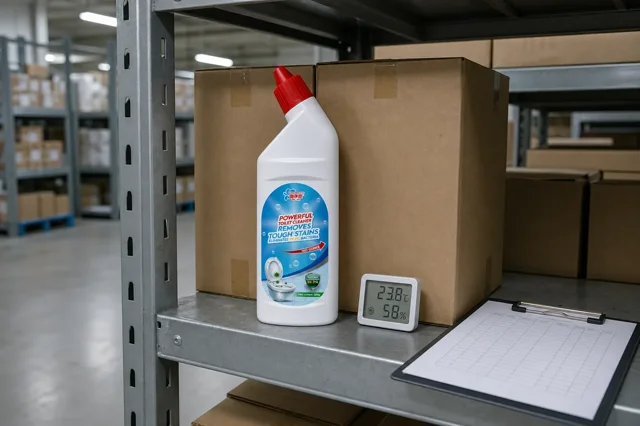
Start with where the product will actually be stored
People usually ask simple questions first: where should cleaning products be stored, and what happens if detergent or toilet cleaner sits in a hot room? Importers have the same question, just with more cartons involved. A private-label SKU may pass a sample review and still create problems if the buyer has not described the storage route clearly.
The RFQ should say where the goods are likely to sit after arrival. A supermarket buyer may care about back-room cartons and shelf rotation. A distributor may hold mixed cleaning products in one warehouse. An e-commerce seller may repack bottles one by one. Those details affect label notes, carton marks and sample checks.
Do not leave storage notes until the label is finished
Before artwork approval, reserve space for storage wording based on the current formula-specific safety information and supplier-approved instructions. Do not infer storage limits, orientation or shelf life from a sample photo or a generic warehouse checklist.
This is buyer-side planning, not legal advice for every market. The importer, local agent or retailer should confirm the required wording for the destination country. Qiaoshou can then keep the product name, label language, carton marks and document file pointed in the same direction.
Check the bottle and closure in the same review
Storage conditions are not only about temperature. They also show whether the bottle, cap, trigger or spout is suitable for the way the carton will be handled. A toilet cleaner bottle, drain cleaner bottle, grease remover trigger and laundry detergent bottle may need different closure checks even if they ship in the same order.
Use empty or inert-filled packaging to review label fit and the proposed carton layout before bulk approval. Ask qualified staff to confirm any filled-product testing, storage constraints and handling requirements against the selected formula and packaging specification.
Make carton marks useful for warehouse staff
Carton marks should help a warehouse identify the SKU without opening every box. At minimum, the buyer should align product name, net content, carton quantity, batch or lot field, destination language needs and any handling mark that the buyer’s logistics team requires.
If one shipment mixes toilet cleaner, drain cleaner, laundry detergent, grease remover and tea stain remover, vague carton names slow receiving work. Clear carton marks also make it easier to match the packing list, commercial invoice and sample approval record when the buyer checks the shipment.
Match SDS and packing documents with the final pack
The document file should not be built after the carton plan is already fixed. Buyers should request SDS or MSDS, COA where applicable, ingredient notes, packing list details and carton information while the label and packaging are still being reviewed.
The same product description should appear across the label, carton, invoice, packing list and document file. If the label says toilet cleaning solution and the document file uses a different product name, the buyer may have to correct paperwork late in the order.
What to send Qiaoshou for a storage-condition review
Send the product type, destination market, sales channel, storage or warehouse concerns, bottle size, cap or trigger requirement, carton quantity, label language, barcode plan, shipment term and requested document list.
With that information, Qiaoshou can review the cleaning-product sample, label storage wording, carton marks, packing details and common export documents together. The quotation then reflects the way the buyer plans to receive, store and sell the product.