
Set a practical scope before discussing contacts
The European Commission’s 11 September 2026 report on International Product Safety Week describes discussions about international cooperation and enforcement in changing e-commerce markets. It is an event report, not a complaint-handling rule or an endorsement of a purchasing procedure. The steps below are practical suggestions for buyers preparing a private-label cleaner order. They concern routine commercial quality queries, such as a reported difference in delivered quantity, and help purchasing teams discover whether their proposed communication arrangements are clear enough to use.
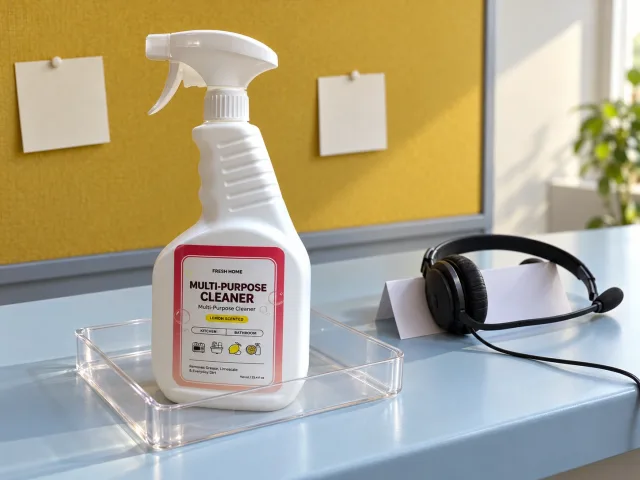
Specify the destination country at the start. Europe includes markets outside the European Union, and a regional sales description cannot settle destination-specific responsibilities. Keep those questions with the appropriate qualified advisers. For a concrete purchasing example, Qiaoshou’s catalogue lists a Fresh Home multi-purpose cleaner in a 750 ml trigger bottle. Use that format to discuss identification and packaging references without treating the catalogue as verified performance evidence. Any actual safety concern belongs with the responsible qualified professionals and applicable processes, outside this commercial rehearsal.
Agree who receives the query and who answers it
Before the first order, ask each party to name a primary routine-query contact, a backup and the agreed communication channel. Record the buyer’s contact alongside the supplier’s, rather than keeping only a salesperson’s address in an old quotation. Discuss working days, time zones and the language in which the parties can exchange order details. Ask what acknowledgment and update timing they can actually agree to. A proposed timetable becomes useful only when both parties confirm it; the catalogue does not establish a service commitment.
Separate receiving a message from owning its answer. The person who acknowledges a query may need purchasing, warehouse or packaging information from someone else. Agree who will collect those answers and keep the buyer informed while they are pending. If the primary contact is away, the backup should know where the current record is held. This conversation can remain short: the important result is a shared understanding of the next person responsible, rather than an impressive-looking contact chart that nobody has agreed to follow.
Make the order identifiable without guessing
Propose a compact query record containing the purchase-order reference, product identifier, ordered quantity and the relevant approved packaging or artwork version. For the 750 ml bottle example, distinguish individual bottles from shipping cartons and identify the pack configuration agreed for that order. Where available, include the production or lot reference shown on the relevant product or shipment record. Ask which references the supplier needs to locate the order. Do not invent a code or assume that a retail barcode identifies a particular production run.
Keep the observation separate from its explanation. A buyer might record that the receiving count differs from the packing list while leaving the cause unconfirmed. Note the date, the count basis and the document used for comparison; attach relevant photographs only when they help clarify the commercial question and can be shared appropriately. A bottle image alone cannot establish how many cartons were delivered. Avoid collecting unrelated customer information for a quantity query. A focused record is easier to review and less likely to obscure what still needs checking.
Try one fictional missing-item handoff
Use a clearly labelled practice example before the order is placed: a fictional receiving record lists one fewer carton than a fictional packing list. State explicitly that no real shipment, customer complaint or loss is being reported. Give the proposed contact the mock order reference and ask them to explain the next handoff. The exercise tests whether the parties understand the information needed and the person responsible for obtaining it. It does not test product safety, establish warehouse accuracy or demonstrate an existing supplier support capability.
Follow the example far enough to expose an unanswered question. Perhaps the receiving count needs checking, or the supplier needs a clearer carton reference. Ask who requests that clarification, who supplies it and who tells the buyer what remains pending. Record the agreed next update rather than assuming the first acknowledgment means resolution. There is no need to invent a refund, replacement or liability decision for the exercise. Those commercial outcomes depend on the actual facts and agreed terms of any real case.
Give unresolved questions an owner before approval
Finish the rehearsal with a short list of unresolved points, each assigned to a named party and a mutually agreed next check. Distinguish a missing piece of information from a decision that needs approval. For example, confirming the carton reference and agreeing who may authorize a commercial remedy are different questions. Ask each party to confirm the part they own. If a response depends on another team, keep a single contact responsible for returning the answer instead of leaving the buyer to chase an unexplained chain.
Carry these arrangements into the first-order discussion with the destination country, intended private-label format and proposed quantity. Review the final product and packaging references when the quotation changes, so the query record still identifies what is being purchased. Ask for confirmation of any service arrangement you intend to rely on; do not infer it from an illustration or general OEM description. The useful outcome is modest and concrete: both parties know where a routine query goes, what identifies the order and who owns the next answer.
Article references
These general references support buyer checks. The importer remains responsible for confirming the rules that apply to the final formula, classification and destination market.