
First, identify the residue and record the wash
Before changing the settings, note what remains: an identifiable pod, transparent fragments, white streaks or general detergent marks. These observations help describe the problem, but they do not establish its cause. Bosch’s residue guidance includes excessive detergent and poor rinsing or drainage, so a white mark alone is not proof that a pod’s film failed to dissolve.
Record where you placed the pod, how tightly the drum was packed, which programme ran and whether it finished normally. Also check whether the machine added liquid detergent automatically. A photograph of the residue and the product directions can make a later support conversation more useful than the statement that the pod did not work.
Check placement and prevent double dosing
Place the pod in the empty drum before loading clothes, as Ariel’s guide describes. Whirlpool says to use a detergent dispenser only when the washer manufacturer directs you to do so. Check your model’s manual instead of assuming that every drawer accepts capsules. Record late placement as one possible explanation, not a confirmed diagnosis.
If your washer has automatic bulk detergent dispensing, follow its instructions for disabling that function when using a pod. Otherwise, the wash may receive detergent from two sources. Do not add another capsule simply because the previous wash left marks. First compare the amount used with the directions for that particular product and load.
Give the load room and choose a compatible cycle
An overpacked drum can interfere with water circulation and rinsing. Bosch describes how laundry can move together as one mass rather than moving freely. If you had to force items into the drum, review the machine’s permitted load for the selected programme. Its maximum capacity is not a promise that every programme can take the same amount or type of laundry.
Whirlpool also identifies exceptionally cold water and an interrupted cycle as possible dissolution problems. That does not justify a blanket ban on cold washing or quick programmes. Compare the pod directions, garment-care labels and machine manual, then let the selected compatible cycle finish. A warmer setting is not an automatic remedy: it must remain suitable for both the fabric and detergent.
Recover the clothing, then investigate repeat problems
For affected clothing, check the care label before choosing a rinse or another wash. Ariel’s own residue advice includes rinsing or rewashing, but its warmer-water suggestion cannot override a garment’s temperature limit. Use a fabric-safe option permitted by your machine and detergent instructions. Adding extra detergent without identifying the problem can complicate the next check rather than resolve it.
If residue keeps returning after placement, loading and programme checks, stop repeating the same wash. Consult the model-specific troubleshooting guidance for rinsing and drainage. Bosch notes that blocked drainage components can leave wash water and detergent behind. Follow the appliance maker’s safe maintenance instructions, or contact service; do not use a general laundry article as a guide to dismantling the machine.
Keep handling and storage safe
Handle capsules with dry hands. Moisture can release their concentrated contents, as the US Consumer Product Safety Commission warns. Keep them in their original packaging, close it fully after use and store it locked away, outside children’s sight and reach. A decorative jar is not an appropriate replacement for the original container, and children should not handle pods.
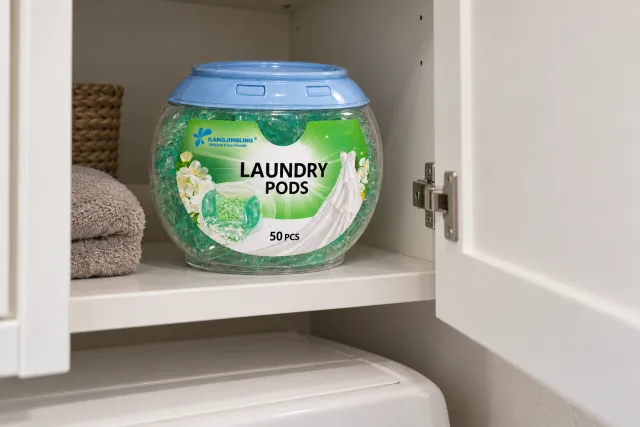
Do not try to open a capsule to make it dissolve faster. Follow the actual pack’s storage and handling directions, and keep the label available for anyone using the washer. The accompanying cabinet illustration shows a closed container; it does not demonstrate that the cabinet is locked or that the product has passed a wash test.
Apply the guidance without inventing product instructions
For readers in Russia, these are practical checks, not Russian regulatory guidance or proof of Qiaoshou performance. The confirmed product information is limited to a pre-dosed format for compatible household washing machines and a 50-piece tub. That count does not establish the number of washes. Obtain the current product directions before assigning a dose, temperature or permitted programme.
The Whirlpool, Bosch and Ariel pages used here were undated when checked on 20 October 2026; the CPSC alert is marked November 2021. They address particular appliances, branded products or general safety, not this formulation. Ariel’s separate product page illustrates why cycle restrictions must stay product-specific. Use these sources to structure troubleshooting, while the actual pack and machine manual determine the instructions.
Article references
These general references support buyer checks. The importer remains responsible for confirming the rules that apply to the final formula, classification and destination market.