
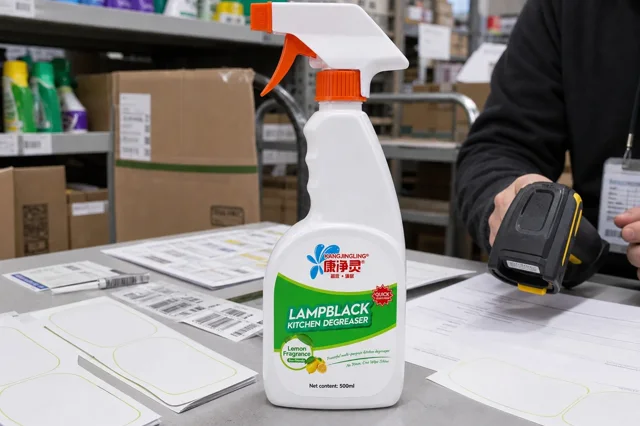
Start with the SKU map, not the new artwork
A private-label cleaning product label refresh usually starts with design: a cleaner front panel, a new color route, a different claim position or a better shelf block. The buying risk is less glamorous. The old SKU name, new label name, barcode, carton mark and packing-list wording all need to describe the same product.
This matters for kitchen degreaser, laundry detergent, drain cleaner, toilet cleaner and powder SKUs. If the bottle says one name while the carton and import documents use another, the buyer may not notice until the warehouse is receiving mixed cases.
Keep customer-facing wording separate from receiving codes
Search questions around cleaner labels are practical: how to label cleaning products, what warnings belong on the pack, where the barcode goes and how much space local language needs. Those are customer-facing questions. Receiving teams also need product name, item code, carton quantity, batch field and barcode owner recorded in a way they can scan and match.
Do not force every internal code onto the front label. Instead, build a small SKU map: old product name, new retail name, product type, net content, barcode, case quantity, carton mark, packing-list name and document-folder name. That file prevents a simple label refresh from becoming a warehouse puzzle.
Check the real pack with the label proof beside it
A PDF proof cannot show every issue. Put the real trigger bottle, pouch, jar or carton next to the new label proof. Check whether the label curve, trigger head, handle, cap, barcode position and warning panel still work on the physical pack.
For a kitchen degreaser, the trigger and neck can hide part of the upper label in shelf photos. If the design uses a bright flavor or fragrance cue, such as lemon, confirm that the product name and use direction still remain clear after the bottle is placed on a retail shelf or in a carton sample.
Update carton marks before the old label leaves the system
Cartons are often the last file someone checks, but they are the first file the receiving team sees. A label refresh should include product name, net content, pieces per carton, SKU or item code, batch field, destination mark and any retailer-specific barcode or case label required by the buyer.
If the order includes both old and new label versions during a changeover, mark them clearly. The buyer should know which cartons belong to the old artwork and which belong to the refreshed label without opening every case.
Make document names follow the final retail name
Common order files may include SDS or MSDS, COA where applicable, ingredient notes, label artwork, carton-mark approval, commercial invoice and packing list. The exact set depends on destination country, sales channel and buyer requirements.
The useful rule is consistency. If the refreshed label says kitchen degreaser while the invoice says grease remover and the SDS or MSDS uses a factory short name, record the mapping before shipment. Do not leave the importer, agent or retailer intake team to guess.
What to send Qiaoshou before a label refresh order
Send the current SKU name, new retail label name, product type, destination market, sales channel, label language, barcode ownership, carton-mark requirement, private-label artwork status, expected quantity and requested document list.
With that brief, Qiaoshou can review the cleaner sample, label space, barcode placement, carton marks and common export documents together. The quotation then reflects the refreshed retail pack the buyer plans to receive and sell, not only the unit price for the bottle.