
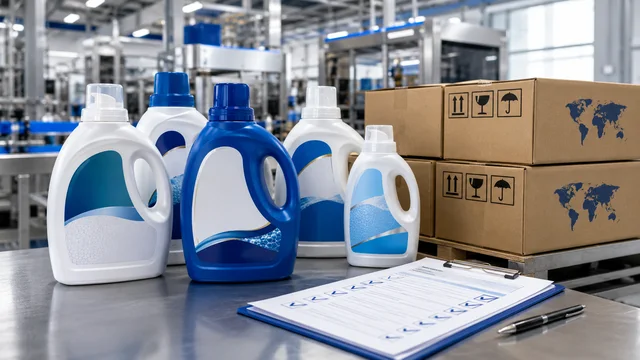
Why Middle East buyers should brief the project before price
A private-label laundry detergent project can move faster when the first inquiry explains the market, channel and product role. Importers in the Middle East often need Arabic or bilingual label space, clear carton marks, stable fragrance direction and documents that can be reviewed before shipment.
If the RFQ only asks for the lowest unit price, the supplier has to guess the bottle size, formula route, label language, carton packing and sample target. That usually creates extra revisions after the buyer has already started comparing offers.
Choose the detergent format first
Liquid detergent, powder and pods serve different shelf roles. Liquid detergent is practical for supermarket and household channels because bottle size, fragrance and label story are easy to adapt. Powder can work for value or family-use programs. Pods can support premium or convenience positioning, but they need stricter packaging and moisture-control review.
Before asking for samples, buyers should state whether they want a single hero SKU or a small laundry range. A clear choice helps the manufacturer quote against the right bottle, cap, carton count, label size and production route.
Define formula and fragrance expectations
A practical brief should describe cleaning expectation, fragrance style, color-care positioning, foam preference and any sensitive-skin or eco-positioning request. These details help the supplier prepare samples that match the buyer channel instead of sending a generic base formula.
Claims should stay specific and reviewable. Buyers can ask for deep cleaning, long-lasting freshness, color care or family-use positioning, but the label language should leave room for local compliance checks and retailer approval.
Packaging and label details for Middle East markets
For Middle East importers, packaging is part of the sourcing decision. The RFQ should include target bottle size, label language, barcode needs, importer information, carton marks and whether the product will be sold through supermarkets, wholesalers or mixed retail channels.
Arabic or bilingual label requirements should be discussed before artwork starts. Back-panel instructions, warning space, fragrance description, net content and usage directions all affect label layout and print approval.
MOQ, samples and lead time
MOQ depends on bottle format, label version, carton printing, fragrance route and whether the buyer is ordering one SKU or building a mixed container. A realistic first order may start with fewer SKUs and a clearer carton plan instead of too many small variations.
Sample review should not be separated from packaging discussion. Buyers should test fragrance, viscosity, cleaning feel, bottle handling, label direction and document availability before confirming bulk production.
Documents to request before shipment
Common document needs include MSDS or SDS, COA, ingredient declaration, commercial invoice and packing list. Depending on the buyer market or retail channel, additional test reports or label review may be requested before final production.
The important point is timing. Documents should be discussed during RFQ and sample review, not after the goods are ready. This gives the importer time to check customs, retailer and warehouse requirements.
RFQ checklist for private-label laundry detergent
A complete RFQ should include destination country, sales channel, detergent format, bottle size, target quantity, fragrance direction, label language, private-label artwork status, carton requirement, shipment term and required documents.
When these details are clear, Qiaoshou can review product feasibility, sample route, packaging direction and documentation needs together. That makes the quotation more useful for importers planning a first order or a repeatable private-label laundry range.
Official reference sources
These general references support buyer checks. The importer remains responsible for confirming the rules that apply to the final formula, classification and destination market.