
A shipment release starts with one controlled SKU
For a Russian importer, a cleaning-product shipment is not controlled by the carton alone. The release file should connect the exact product description, formula or material information, retail pack, label revision, net content, product identifier, carton count and destination. Rospotrebnadzor’s 20 July 2026 notice points businesses to checking marking obligations through TN VED EAEU or OKPD codes and to keeping product cards and system data accurate. That is a reason to make the SKU record the starting point for dispatch, not a reason to assume every cleaner follows the same route.
The Federal Centre for Hygiene Education’s regulatory summary adds a separate control point: Russia’s technical regulation on chemical products sets requirements for chemical products, identification, packaging and marking, but its main provisions take effect on 1 September 2027 with transition periods. A shipment planned today therefore needs a dated review of the rule that applies now, the future transition question and the information the broker or carrier needs. The supplier catalogue, product image or generic product name cannot answer that case-specific question.
Transit information is not a shipment authorization
The Eurasian Economic Commission reported on 4 September 2026 that its customs minister discussed digital customs operations and legally significant information exchange at the Eastern Economic Forum. The report also describes an EAEU common customs transit agreement that entered into force at the end of June and identifies electronic declarations, recognition of customs-control results and navigation seals as elements of the transit system. This is a description of a union-level initiative, not a statement that every cleaning-product load needs a seal or can use a particular simplified process.
For a buyer, the practical connection is data continuity. Ask the broker whether this route uses transit procedures, which party submits the declaration, and which product and consignment identifiers must agree across commercial and transport records. Record the broker’s answer rather than reproducing a general conference statement as a mandatory instruction. Distinguish a proposed information-exchange arrangement with a trading partner from an agreement already in force. If the route changes after the sample and packing plan were signed off, check whether the declaration and carrier file need to change too.
Match the physical pack to the document set
Before booking a load, compare the bottle or jar, label artwork, carton drawing and product documents side by side. The product name, net content, SKU code, pack count and destination language should identify the same revision. Keep formula description, ingredient declaration, SDS or MSDS, COA when requested, commercial invoice and packing list in the same controlled folder. Qiaoshou’s catalogue lists shipment documents by product family, but the final document set must be confirmed against the selected formula, market and buyer request rather than copied from another SKU.
Use a simple difference log. Record whether the sample, bulk pack or document has changed; who approved the change; and whether the change affects classification, warning wording, code area, carton quantity, pallet plan or carrier information. A new fragrance, bottle size, closure, label language or formula can create a new review even when the product keeps the same commercial name. Keep the old revision visible as history, but do not mix its document fields into the release file for the current shipment.
Ask transport questions without inventing a hazard status
A cleaning product may be an ordinary consumer shipment, or it may require additional carrier information because of its formula, concentration, packaging or transport mode. Do not label a product as dangerous goods, non-dangerous goods or exempt from a requirement based on a marketing name. Give the carrier, freight forwarder or broker the exact formula description available to the responsible technical owner, the SDS, pack construction, quantity, route and mode. Ask them to confirm the information and documents required for that actual shipment.
The importer should assign ownership for unresolved transport questions. The supplier can provide formula, pack and document inputs; the carrier or broker can state route and booking requirements; a qualified local adviser can confirm Russian legal or classification questions. Put the answer, source, date and person responsible into the shipment file. If the carrier asks for a revised SDS, outer-pack detail, pallet restriction or additional declaration, treat that as a release action, not as a last-minute administrative edit after loading.
Set a release gate before the truck or container is booked
A practical release review has four passes. First, reconcile the physical sample or approved bulk specification with the current label and carton. Second, reconcile the label and SKU with the invoice, packing list, SDS and product-data record. Third, check the destination-market scope, marking status and any transition date with the importer’s responsible specialist. Fourth, send the controlled data to the broker or carrier and record the reply. Do not confuse a clean-looking bottle or a complete-looking packing list with proof that the shipment has passed every market-specific review.
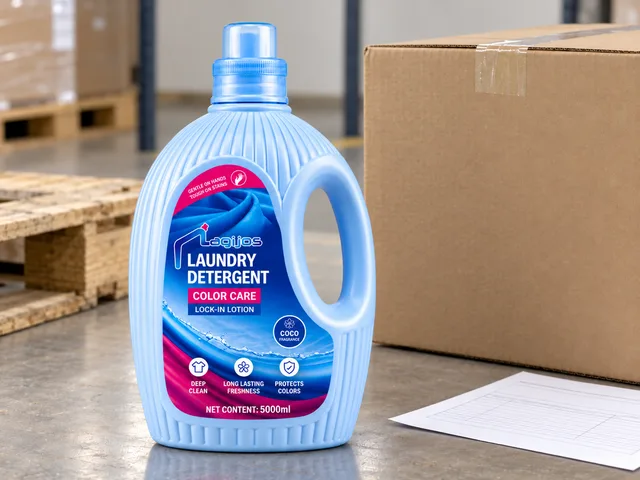
For the Lagijos 5,000 ml laundry-detergent reference shown here, the image is only an editorial illustration of a catalogue product format. It does not prove a Russian classification, marking status, transport acceptance, leak test, efficacy or customer shipment. Request a sample, document pack and OEM quotation with the destination, quantity, label language, carton plan, shipment route and required confirmations. If formula, packaging or classification remains open, hold dispatch and reopen the review instead of letting the shipping date force an unsupported decision.
Article references
These general references support buyer checks. The importer remains responsible for confirming the rules that apply to the final formula, classification and destination market.