
The 1 July milestone concerns checkout equipment
For an importer, the practical change to verify first is the retail transaction. A 3 July 2026 notice on the Klyuchevsky District administration portal says that, from 1 July 2026, cash-register equipment became mandatory when covered cosmetics and household chemicals are withdrawn from circulation through retail sales. The consumer-protection portal reported the same retail milestone on 18 June 2026.
Treat the notice as an operational checkout-readiness requirement, not proof that a label alone is sufficient. The physical pack, importer record, warehouse item and cash-register master-data entry should identify the same SKU revision. Assign an owner to supplier data, importer records, warehouse receipt and retailer setup. A printed barcode or supplier declaration does not establish that the importer has confirmed the applicable withdrawal process. Differences can still arise after a label revision, assortment merge or carton change.
Scope starts with classification, not with a product nickname
Both official notices point to a scope question that should be answered at SKU level. A commercial name such as bathroom cleaner, wipes or hygiene product does not by itself prove that a specific item is covered. The importer should check the exact product description and the relevant classification and marking rules, then document the result instead of copying a decision from another product family.
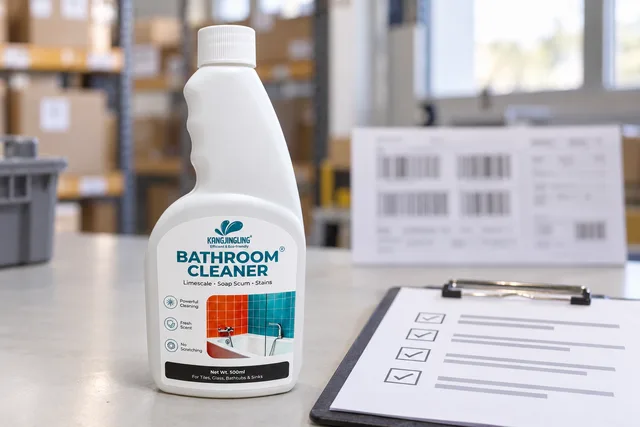
Use the 500 ml Kangjingling Bathroom Cleaner image in this article only as a procurement example of a retail pack that needs a market-specific review. The image does not prove that this product is marked, registered or legally classified for Russia. Before approving Russian artwork or a replenishment order, record the exact category, identifiers, code field, retail master-data entry and transition treatment confirmed by the responsible specialist.
Existing product flows and new category rules must be kept apart
The 18 June 2026 Rospotrebnadzor publication summarizes earlier product phases: soap and detergents from 1 May 2025, hair products, deodorants and shaving products from 1 July 2025, and cosmetics and toothpaste from 1 October 2025. It also states that retail withdrawal of covered cosmetics and household chemicals through cash-register equipment becomes mandatory from 1 July 2026. Buyers should read these as category and process milestones, not as a single universal rule for every cleaner.
This distinction matters when an importer has old inventory, a new packaging run and several product families in one shipment. Keep separate rows for legacy stock, new stock, marking status, warehouse receipt, checkout master data and confirmed withdrawal treatment. Record the source, confirmation date and decision owner for each row. If the published notices do not resolve a product or transition case, hold the artwork or shipment decision and obtain local confirmation rather than guessing.
A buyer-ready specification prevents a last-minute label rewrite
Add a marking section to the RFQ before the supplier starts artwork. Record the destination market, importer of record, exact product and packaging codes, pack dimensions, label language, barcode or identification-code area, carton configuration, shipment timing and the documents needed for data exchange. For a bathroom cleaner, also freeze the final formula reference, target surfaces and warning wording before approving the back panel. Formula, label and code decisions should refer to the same SKU revision.
Then request a controlled sample review: one physical retail pack, one carton-mark drawing and one product-data checklist. Confirm who maintains product identifiers, who owns retailer master-data setup, how imported stock is reconciled and what happens when artwork changes. Qiaoshou can discuss the 500 ml angled-neck sample, label language, carton marks and export documents against a buyer brief; the Russian importer remains responsible for current local confirmation. Keep the approved artwork, sample photos, product identifier, packing list and written scope decision together in the purchase file. Before issuing the purchase order, the buyer can turn this into a release checklist. Record the legal entity that will import, the intended sales channel, the exact SKU and pack size, the artwork revision, the stock group and the person who approved the Russian scope decision. Set explicit stop conditions: an unknown category, a changed formula, a changed pack identifier, an unresolved old-stock question or retailer master data that does not match the approved file. Reopen the review whenever one of those inputs changes. This creates an auditable procurement trail without treating Qiaoshou, a product image or a general article as Russian legal advice.
Inventory scenario, buyer action and supplier file
| Inventory scenario | Importer action | Supplier deliverable | Decision owner |
|---|---|---|---|
| Already imported stock | Confirm marking and sale-status treatment with the Russian operator or adviser before release | Pack photos, batch/SKU list, label and carton fields | Importer / Russian marking operator |
| In transit or not yet imported | Hold the shipment decision until scope, code placement and checkout setup are confirmed | Final SKU, pack size, barcode, artwork and packing list fields | Importer with broker or adviser |
| New packaging run | Freeze code position, label version and carton mapping before production approval | 500 ml sample, label file, carton marks and document checklist | Buyer artwork owner + supplier |
| Classification uncertain | Do not assume coverage from a product name; obtain Russian classification advice | Formula/product description and pack data for the buyer’s review | Importer / qualified Russian adviser |
Article references
These general references support buyer checks. The importer remains responsible for confirming the rules that apply to the final formula, classification and destination market.