
Start with a job list, not an all-surface promise
A multi-purpose cleaner can be an attractive starting point for a compact retail range. The buying decision becomes clearer when the importer defines which everyday jobs the product is being considered for. A kitchen counter, a bathroom fitting and a washable wall tile are different assignments, even when customers find them in the same home. Build the range around specific proposed uses, then ask which of those uses the selected formula and its instructions actually support.
NEA’s 4 September 2026 update describes Singapore’s continued efforts to improve public toilet cleanliness. That local context is a useful prompt to discuss cleaning routines; it does not endorse any cleaner. The use map below is a buyer-side planning method, not an NEA protocol. It helps distributors serving Southeast Asia connect a sample request with the tasks retail staff will later need to explain, without treating Singapore’s context as a rule for every regional market.
Separate the room from the material and finish
Give each proposed job its own line: room or zone, object, surface material, finish, type of visible dirt, and the customer’s intended result. For example, a bathroom display might include a glazed tile and a coated cabinet panel. Record these as separate proposed uses. Do not convert a general bathroom description into permission for every fitting, seal, painted surface or decorative finish that happens to be present in that room.
Add a status beside every line: supported by the current instructions, awaiting supplier confirmation, or outside the proposed offer. These are your purchasing categories, not official classifications. If the surface supplier’s care instructions and the cleaner’s directions do not clearly support the same job, leave it unresolved. Photograph the sample surface and record its material description so that a later answer refers to the actual example rather than a broad word such as stone, metal or plastic.
Turn directions into questions before the trial
Ask for the directions associated with the exact formula offered, including any surface exclusions. Your review questions can cover whether the product is supplied ready to use, how it is applied, what quantity guidance is available, whether a waiting step is specified, and what wiping or rinsing follows. These are questions for the supplier, not instructions to improvise. Do not publish a dilution ratio, contact time or no-rinse statement merely because another spray uses one.
Treat cleaning, disinfection, food-contact suitability and fragrance as separate questions. The catalog’s everyday cleaning description does not itself establish a disinfectant claim or permission for a food-contact application. Lemon-scented positioning is not a measure of cleaning outcome. If the proposed retail demonstration relies on any additional claim, keep that demonstration on hold until its wording and supporting evidence are reviewed. For unresolved applications, ask for clarification rather than trying combinations or stronger application methods.
Use a small comparison record for the sample
Before arranging a trial, agree the sample identity, the proposed surface, the applicable directions and who will record observations. Where a trial is appropriate, follow those directions and the surface’s care requirements. Record the starting condition, the steps actually followed and the appearance afterward. Include observations such as visible residue, streaking or an unexpected change in finish without turning a single observation into a broad performance claim. An unanswered compatibility question remains unanswered after a photograph.
If two samples are compared, describe the same proposed task and record differences in the instructions instead of silently making the procedures identical. Keep the bottle or sample code, formula reference where provided, date and observer’s name with the notes. The purpose is to decide what needs further review, what fits the buyer’s proposed use, and what should be excluded. This practical comparison does not replace laboratory evidence, a safety assessment or any destination-specific requirement.
Carry the same use boundaries into every language
Once the use list is settled, prepare a short briefing for the people who will describe the product: the intended jobs, the exclusions, the approved directions and the route for unanswered questions. A retailer’s product page, a shelf explanation and a staff demonstration should not quietly add different surfaces. Keep a dated master list so a wording change can be reviewed across all those touchpoints before it becomes a new promise to the customer.
Southeast Asia needs country-specific planning. State the destination country and the actual languages your channel uses; a Malay edition does not cover every regional customer. Ask the local reviewer to check meaning as well as fluency. In particular, a translation must not turn suitable washable surfaces into all surfaces, or ordinary cleaning into disinfection. Keep any required local review separate from the commercial decision to request a sample, and leave unresolved wording clearly marked.
Send Qiaoshou a focused Fresh Home sample brief
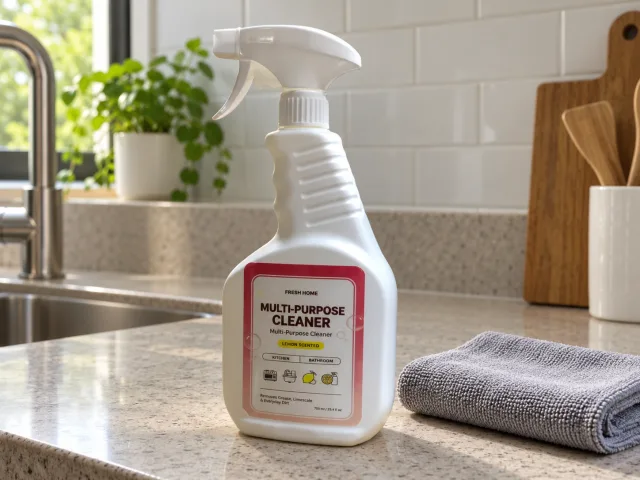
Qiaoshou’s current catalog lists the Fresh Home multi-purpose cleaner in a 750 ml trigger bottle, with lemon-scented positioning on the current sample. Its stated scope is everyday kitchen, bathroom and suitable washable hard-surface cleaning. This description is a starting point for the use map, not confirmation for every material. The catalog leaves the selected formula’s shelf life and ingredient declaration to confirmation, and makes sample timing dependent on the agreed product and packaging direction.
Send the destination country, sales channel, target quantity, label languages, fragrance or formula direction and requested documents together with your proposed-use list. Identify the surfaces awaiting confirmation and the questions that must be answered before a sample demonstration. Ask for the applicable directions and the available documents for the final formula. MOQ, packing details and timing need quotation-stage confirmation. This gives Qiaoshou a concrete sample enquiry and gives your team a clear basis for the next decision.
Article references
These general references support buyer checks. The importer remains responsible for confirming the rules that apply to the final formula, classification and destination market.