
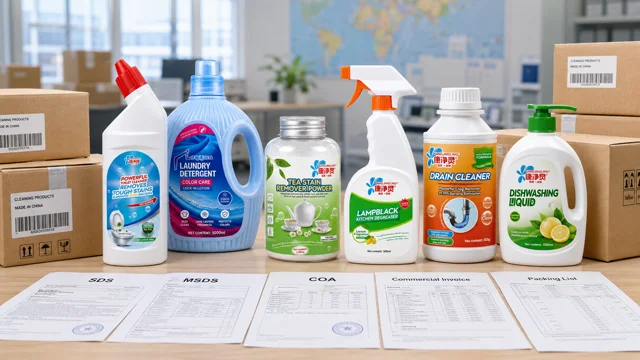
Most document problems start before customs
Many document problems do not start at the port. They start earlier, when a buyer asks for a price but leaves out the destination country, label language, warning text, carton marks or document requirements.
For cleaning products, that small gap matters. A drain cleaner, toilet cleaner, kitchen degreaser or laundry detergent is not only a bottle with liquid inside. Importers may need SDS or MSDS, COA, ingredient information, warning copy, commercial invoice, packing list and carton details before the goods can move smoothly.
Ask about SDS or MSDS before sample approval
If the product is a drain cleaner, degreaser, toilet cleaner or laundry detergent, ask about SDS or MSDS early. Your warehouse, forwarder, importer or retail customer may ask for it before shipment.
The document should be discussed while the formula and product name are still being confirmed. If the formula, concentration, fragrance or label direction changes later, the safety document may need another review. It is much easier to handle this before bulk production than after cartons are packed.
A COA should match the product being shipped
A COA is useful only when it matches the actual product, batch or specification being shipped. Buyers should not treat it as a decoration for the file.
If you need appearance, net content, viscosity, pH range, active matter or another item shown on the COA, say that before production. Some items are routine. Some need extra checking. The supplier cannot guess which version your importer, retailer or local agent expects.
Ingredient information and claims need early review
Ingredient information is usually simple when the order is simple. It becomes messy when the buyer changes fragrance, color, claim or market after artwork has already started.
Claims also need care. Words like antibacterial, eco, baby safe, heavy duty or professional strength may sound good on a label, but different markets and retailers may ask for different support. It is better to mark these claims in the first brief instead of adding them in the final artwork file.
Label review should happen before artwork is locked
Label problems are annoying because they usually appear late. The front label may look good, but the back label may have no room for warning text, importer information, usage directions, local language or barcode placement.
For private label cleaning products, the label should be checked before printing. Buyers should send the destination market, label language, required importer details and any warning sentence that must appear. A small label change can affect bottle choice, sticker size, carton marks and production timing.
Shipping papers and carton marks should tell the same story
Commercial invoice, packing list and carton marks should match the goods that are actually packed. Product name, quantity, carton count, net weight, gross weight and consignee details should not be invented at the last minute.
This is especially important for mixed containers or private label orders with several SKUs. If the carton mark says one thing and the packing list says another, the problem usually reaches the buyer when nobody wants more questions: right before shipment.
What to put in the RFQ
A useful RFQ should include the product type, destination country, sales channel, bottle or pack size, target quantity, label language, private label artwork status, carton requirement and document list.
For document requests, be direct. Say whether you need SDS or MSDS, COA, ingredient declaration, commercial invoice, packing list, carton marks, barcode placement or retailer label review. The quotation will be slower by a few minutes, but the project will usually save days later.
How Qiaoshou handles document discussions
Qiaoshou can discuss common documents such as MSDS or SDS, COA, ingredient declaration, commercial invoice and packing list for verified RFQs. The exact document set depends on the product, formula, destination market and buyer channel.
When buyers share the document needs early, Qiaoshou can review formula, packaging, label and carton details together. That makes the quote more useful, and it reduces the awkward back-and-forth that happens when a document request arrives after production.
Official reference sources
These general references support buyer checks. The importer remains responsible for confirming the rules that apply to the final formula, classification and destination market.